

We start with nutrition.
Nutrition is complicated, and the internet hasn't helped. One week a food will save you, the next week it's killing you.
Huel takes a more balanced view. Work out what an adult needs from a meal. Deliver that and then make it tasty.
Every Huel meal carries a balanced macronutrient profile and all 26 essential vitamins and minerals. Formulated by nutritionists, tested by independent researchers, and refined over a decade.
Think of us as your personal nutritionist and chef.
The formula explained
Huel started as a spreadsheet. Protein, fats, carbohydrates, fibre and 26 vitamins and minerals, based on recommended intakes for what an adult needs across a day, built into something people would want to eat.
Every product since has been made the same way round. Most food we buy is developed without nutrition in mind. Not at Huel. At Huel we are nutrition first.
Protein
Protein does more than build muscle, and you need it at every age. Every Huel meal uses a blend of plant proteins that together cover all nine essential amino acids. Protein contributes to the maintenance of muscle mass [4].
Fibre
The importance of fibre isn’t new. We’ve known this since our first powder was developed in 2015. Fibre in Huel is derived from flaxseed, oats, chicory, corn, pulses and vegetables, soluble and insoluble. UK adults are advised to eat 30g a day. Most manage around 20g.
Carbohydrates
We like carbs. Strictly speaking they aren't essential, since the body can make energy from fat and protein, but they're its first choice for immediate fuel [10]. Huel Powder leans on oats and tapioca. Our Black Edition runs lower in carbohydrate for those that need that.
Fats
Fat spent thirty years cast as the villain, which was never right. Two fatty acids can't be made by the body at all: omega-3 ALA and omega-6 LA. Both arrive in Huel mostly from flaxseed and sunflower, balanced in ratio.
Vitamins and minerals
For a lot of food products, vitamins are a finishing touch. For Huel they're the reason the formula exists. Every meal carries all 26 essential vitamins and minerals, dosed against what the whole-food ingredients already provide, so the amount you get is actually useful.
Superfoods and phytonutrients
Phytonutrients are found in plants and can be beneficial to human health [29,30]. They aren't classed as essential for life, but we would consider a few of them optimal. Huel is built from plants, so many are found within the whole ingredients.

Protein
The UK reference intake is 0.75g per kilogram of body weight per day (which roughly works out to 50g a day) [1,2,3]. That figure is a minimum rather than a target: enough to prevent deficiency, not much more. If you're doing anything from walking to working out, you need more [5].
Most plant proteins are not complete proteins. For example brown rice protein is rich in methionine and cysteine and low in lysine. Pea and faba bean protein are the other way round. Used together, the profile is complete. That's why our meals draw on two or three sources instead of one.
Protein is found in your skin, blood, bones, and organs, even some of your hormones are made of protein [6]. So we've made sure you're getting enough.
Fibre
Fibre is the part of a plant your body doesn't break down. The main role of fibre is to keep things running smoothly [7]. Fibre works like a sponge, so when increasing your fibre intake it is important to stay hydrated [8].
Only about 1 in 25 UK adults reaches the target [9]. Protein gets all the attention; fibre is where many diets actually fall short.
Soluble and insoluble forms do different jobs, and we need both, which is why ours comes from a mix of whole ingredients rather than one added source.

Carbohydrates
Carbohydrate is also your brain's preferred energy source [10].
The carbohydrate content you want depends on what you want from the meal, so our range varies on purpose. Huel Powder takes 37% of its energy from carbohydrates. Black Edition takes 17%, using tapioca as its main source. The hot meals get theirs from brown rice, pasta and noodles.
Our Huel meals have a low glycaemic index, which is a measure of how quickly a carbohydrate raises blood sugar after you eat it [11,12]. Slower release, and a gentler rise in blood sugar [13,14]useful for when the snack cupboard is calling at four o'clock. We've written a longer explainer on glycaemic index and load here if you want the detail.
Fats
It carries flavour, helps absorb some vitamins, and is essential for your body to function [17,18].
The balance is the difficult part of getting fat right, and it's the part we've done for you. Most Western diets get plenty of omega-6 and not enough omega-3, and it's the ratio between them that matters, not just the totals [18,19]. Flaxseed and rapeseed cover the omega-3, sunflower the omega-6.
Why do we use seed oils? Seed oils get blamed for junk food's sins. But junk food is bad because it's hyper-palatable and easy to overeat, not because of what oil it's cooked in [20,21]. We've published our position and the evidence behind it rather than accept misinformation and bad science.

Vitamins and minerals
Most of the micronutrients come from the ingredients themselves. The blend is then built to fill the precise gap between that and a balanced day, which is a different job from tipping a multivitamin into a recipe, and it's why the blend differs between products.
What no one tells you is that these nutrients interact with each other. Vitamins A, D, E and K need fat present to be absorbed, and in a Huel meal the fat is already there. Vitamin C increases iron absorption, and Huel is a source of both [22,23,25,26]. Flaxseed naturally contains phytic acid, which binds to some minerals and makes them harder to take up, so iron and zinc levels are set with that in mind rather than ignored [27].

Superfoods and phytonutrients
Research shows that they have a role in preventing various diseases [29,30,31,32]. The evidence behind them ranges from solid to thin, so we are careful to select the ones we believe are the best bang for buck.
Some ingredients such as oats, brown rice, flaxseed and tomatoes naturally bring a range of phytonutrients. Some Huel products also contain additional phytonutrients as part of their vitamin and mineral blend.
Ingredients with a purpose
Every ingredient in a Huel product has a reason to be there, and there are fewer of them than you'd expect.
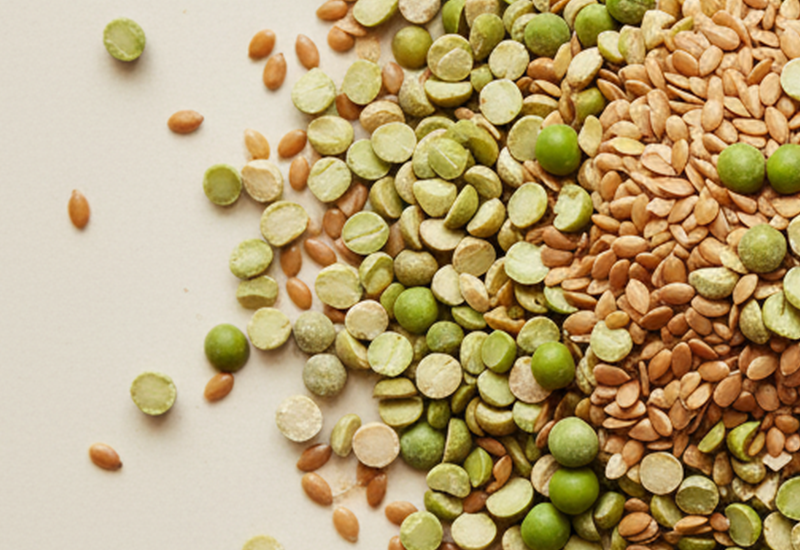
Protein comes from peas, faba beans and brown rice. Carbohydrate from oats, tapioca, brown rice, pasta or noodles, depending on the product. Fats from ground flaxseed and rapeseed and sunflower, with MCTs from coconut in some formulas. Fibre arrives with those whole ingredients. On top of all that sits the micronutrient blend, built to close the gap between what the food provides and what a balanced day needs.
We use flavourings, sweeteners and thickeners sparingly and in precise amounts. A meal you don't finish is worth nothing nutritionally, so taste and texture are part of the formulation rather than an afterthought.
What we leave out: animal products, GMOs, artificial colours and artificial flavours. Black Edition is sweetened with stevia. Gluten-free versions of Huel Powder use oats grown and processed in a gluten-free environment and are certified by Coeliac UK.
We've done the thinking.
Some of this is complicated. Amino acid profiles, absorption, fatty acid ratios. It has taken proper research to get right.
None of that is yours to think about. That's the point of Huel. Open it, make it, get on with your day.

References
- COMA. Dietary reference values for food energy and nutrients for the United Kingdom. Report of the Panel on Dietary Reference Values of the Committee on Medical Aspects of Food Policy. Rep Health Soc Subj (Lond). 1991; 41:1-210.
- FoodDrinkEurope. Guidance on the Provision of Food Information to Consumers Regulation (EU) No. 1169/2011 2013 [Available from https://www.fooddrinkeurope.eu/uploads/publications_documents/FDE_Guidance_WEB.pdf.
- British Nutrition Foundation. Nutrition Requirements Revised 2019 [Available from https://www.nutrition.org.uk/attachments/article/261/Nutrition%20Requirements_Revised%20August%202019.pdf.
- EFSA NDA Panel, 2010. Scientific Opinion on the substantiation of health claims related to protein... growth or maintenance of muscle mass (ID 415, 417, 593, 594, 595, 715)... EFSA J. 8, 1811.
- Jäger R, et al. International Society of Sports Nutrition Position Stand: protein and exercise. Journal of the International Society of Sports Nutrition. 2017; 14(1):20.
- LaPelusa A, Kaushik R. Physiology, proteins. In: StatPearls [Internet]. Treasure Island (FL): StatPearls Publishing; 2026. Available from: https://www.ncbi.nlm.nih.gov/books/NBK555990/
- EFSA Panel on Dietetic Products, Nutrition, and Allergies (NDA); Scientific Opinion on Dietary Reference Values for carbohydrates and dietary fibre. EFSA Journal 2010; 8(3):1462 [77 pp.]. doi:10.2903/j.efsa.2010.1462.
- Gallaher D. Dietary Fiber. Washington D.C.: ILSI Press; 2006. p. 102-10.
- British Nutrition Foundation. Fibre [Internet]. Available from: https://www.nutrition.org.uk/nutritional-information/fibre/
- Jéquier E. Carbohydrates as a source of energy. Am J Clin Nutr. 1994;59(3 Suppl):682S-685S.
- Brouns F, et al. Glycaemic index methodology. Nutr Res Rev. 2005; 18(1):145-71.
- Esfahani A, et al. The glycemic index: physiological significance. J Am Coll Nutr. 2009; 28 Suppl:439S-45S.
- Cocate PG, et al. Metabolic responses to high glycemic index and low glycemic index meals: a controlled crossover clinical trial. Nutr J. 2011; 10:1-.
- Kaur B, et al. The impact of a low glycaemic index (GI) diet on simultaneous measurements of blood glucose and fat oxidation: A whole body calorimetric study. J Clin Transl Endocrinol. 2016; 4:45-52.
- Holt SH, et al. A satiety index of common foods. Eur J Clin Nutr. 1995; 49(9):675-90.
- Pasman WJ, et al. Effect of two breakfasts, different in carbohydrate composition, on hunger and satiety and mood in healthy men. Int J Obes Relat Metab Disord. 2003; 27(6):663-8.
- Simopoulos AP. The importance of the ratio of omega-6/omega-3 essential fatty acids. Biomed Pharmacother. 2002; 56(8):365-79.
- Stevens SL. Fat-Soluble Vitamins. Nurs Clin North Am. 2021 Mar;56(1):33-45. doi: 10.1016/j.cnur.2020.10.003. PMID: 33549284.
- Food Standards Agency. FSA nutrient and food based guidelines for UK institutions. London2007.
- Fornari Laurindo L, et al. Evaluating the effects of seed oils on lipid profile, inflammatory and oxidative markers, and glycemic control of diabetic and dyslipidemic patients: a systematic review of clinical studies. Front Nutr. 2025;12:1502815.
- Nagra M, Goldman DM, Belury MA, Messina M. Concerns about the health effects of industrially produced seed oils are without scientific foundation: a scoping narrative review of the clinical and observational evidence. Crit Rev Food Sci Nutr. 2026;66(27):5386-5445
- .Deruelle F, et al. Vitamin C: is supplementation necessary for optimal health? Journal of alternative and complementary medicine (New York, NY). 2008; 14(10):1291-8.
- Combs J, et al. The Vitamins. 4th ed. Burlington: Elsevier Science; 2012.
- Hathcock JN, et al. Vitamins E and C are safe across a broad range of intakes. American Journal of Clinical Nutrition. 2005; 81(4):736-45.
- Sharma DC, et al. Correction of anemia and iron deficiency in vegetarians by administration of ascorbic acid. Indian J Physiol Pharmacol. 1995; 39(4):403-6.
- Siegenberg D, et al. Ascorbic acid prevents the dose-dependent inhibitory effects of polyphenols and phytates on nonheme-iron absorption. Am J Clin Nutr. 1991; 53(2):537-41.
- Graf E & Eaton J. Antioxidant functions of phytic acid. Free Radic Biol Med. 1990; 8(1): 61-9.
- Zeisel SH, et al. Choline: an essential nutrient for public health. Nutr Rev. 2009; 67(11):615-23.
- Wilcox MD, Chater PI, Stanforth KJ, Williams R, Brownlee IA and Pearson JP (2022) A Pilot Pre and Post 4 Week Intervention Evaluating the Effect of a Proprietary, Powdered, Plant Based Food on Micronutrient Status, Dietary Intake, and Markers of Health in a Healthy Adult Population. Front. Nutr. 9:945622. doi: 10.3389/fnut.2022.945622
- Institute LP. Oregon State University α-Carotene, β-Carotene, β-Cryptoxanthin, Lycopene, Lutein, and Zeaxanthin. Available from: https://lpi.oregonstate.edu/mic/dietary-factors/phytochemicals/carotenoids
- Richer S, et al. Double-masked, placebo-controlled, randomized trial of lutein and antioxidant supplementation in the intervention of atrophic age-related macular degeneration: the Veterans LAST study (Lutein Antioxidant Supplementation Trial). Optometry. 2004; 75(4): 216-30.
- Daou C & Zhang H. Oat Beta-Glucan: Its Role in Health Promotion and Prevention of Diseases. Comp Rev Food Sci & Food Safety. 2012; 11(4): 355-65